
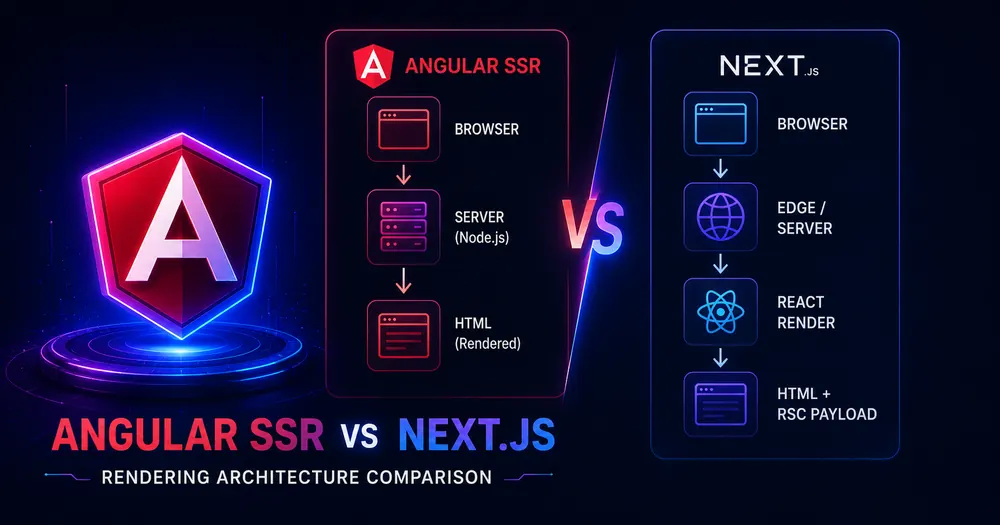
The question comes up on every greenfield project: Angular SSR or Next.js? Both render on the server. Both can prerender static pages. Both hydrate in the browser and support modern tooling. At a surface level they’re solving the same problem, and the marketing copy for each sounds nearly identical.
Under the hood they take fundamentally different approaches — and picking the wrong one for your context costs months of fighting the framework instead of shipping. The render model is different, the hydration story is different, the deployment complexity is different, and the team skills required are different.
Here’s an honest breakdown of where each framework wins in 2026, so you can make the call once and move on.
Table of Contents
- Rendering Models: Explicit Config vs Implicit Defaults
- ISR and Incremental Caching: Next.js’s Biggest Advantage
- Hydration: Where the Models Diverge Most
- Developer Experience and Learning Curve
- Deployment and Infrastructure
- How Should You Actually Choose?
- Comparison at a Glance
- Conclusion
- FAQ
Rendering Models: Explicit Config vs Implicit Defaults
Angular and Next.js both support SSR, static prerendering, and client-side rendering — but they reach for them very differently.
Angular SSR makes rendering a deliberate per-route decision. You write a ServerRoute[] in app.routes.server.ts and assign RenderMode.Server, RenderMode.Prerender, or RenderMode.Client to each path. Nothing renders on the server unless you opt into it:
// app.routes.server.ts — Angular 21
export const serverRoutes: ServerRoute[] = [
  {path: '', renderMode: RenderMode.Prerender},
  {path: 'product/:id', renderMode: RenderMode.Server},
  {path: 'dashboard/**', renderMode: RenderMode.Client},
  {path: '**', renderMode: RenderMode.Server},
];Code language: TypeScript (typescript)
Next.js (v16, App Router) goes the other direction — server rendering is the default. Every component in the /app directory is a React Server Component unless you put 'use client' at the top. You then use route segment config to override:
// app/product/[id]/page.tsx — Next.js 16
export const dynamic = 'force-dynamic'; // SSR on every request
export const revalidate = 3600;          // or: ISR, rebuild every hour
export default async function ProductPage({params}) {
  const product = await fetchProduct(params.id); // runs on the server
  return <div>{product.name}</div>;
}Code language: TypeScript (typescript)
The philosophical difference matters in practice. Angular’s explicit opt-in means every rendering decision is visible and reviewed — good for large teams where nobody should accidentally server-render an authenticated page. Next.js’s server-first default is faster to ship but easier to misconfigure silently.
For a deeper look at how Angular assigns modes per route, the render modes guide walks through the decision framework.
ISR and Incremental Caching: Next.js’s Biggest Advantage
This is the most meaningful gap between the two frameworks in 2026, and it’s worth being direct about it.
Next.js has Incremental Static Regeneration — pages prerendered at build time can be revalidated in the background on a timer (revalidate = 3600) or on demand, so content stays fresh without a full rebuild. On top of that, Next.js 16 introduced Cache Components as the PPR (Partial Prerendering) model, enabled via cacheComponents in your config. This lets a single route serve a static shell instantly from the CDN edge while dynamically streaming personalized sections in the same HTTP response:
// next.config.ts — Next.js 16 PPR via Cache Components
import type {NextConfig} from 'next';
const nextConfig: NextConfig = {
  cacheComponents: true,
};
export default nextConfig;Code language: TypeScript (typescript)
A product page can show the layout, header, and above-the-fold imagery from a CDN cache — under 100ms — while the user’s cart, recommendations, and pricing stream in from the server. No client-side fetch required for either. One request, one response.
Angular SSR has no equivalent of ISR or PPR. Your prerendered pages are built once at ng build and stay static until the next deploy. Per-request SSR (RenderMode.Server) is fresh every time but requires the Node server to run for every hit. There’s no time-based revalidation, no background rebuild, no edge-cached dynamic streaming. For a content-heavy product that changes often — an e-commerce catalog, a news feed, anything with user-specific and shared content on the same page — that gap is real and worth acknowledging before you choose Angular.
Hydration: Where the Models Diverge Most
Angular hydrates the full application. The server renders the HTML; the browser downloads Angular’s runtime, boots it, and walks the existing DOM to attach event listeners. provideClientHydration() orchestrates this, and the transfer cache prevents duplicate API calls during the handoff. It’s efficient — but the client still runs Angular and all your component code.
Next.js with React Server Components (RSC) takes a different approach. Server Components render only on the server and send zero JavaScript to the client. Client Components (marked with 'use client') render and hydrate normally. A well-structured Next.js app ships far less JavaScript to the browser because most of the component tree never needs to run there.
// ServerComponent.tsx — no JS sent to client
async function ProductList() {
  const products = await db.getProducts();
  return products.map(p => <ProductCard key={p.id} product={p} />);
}
// 'use client' — hydrates normally, receives JS
'use client';
function AddToCartButton({productId}: {productId: string}) {
  return <button onClick={() => addToCart(productId)}>Add to cart</button>;
}Code language: TypeScript (typescript)
This is a fundamentally different mental model. Angular treats every component as potentially interactive and ships accordingly; Next.js assumes components are static by default and makes you explicitly opt into interactivity. For content-heavy apps — marketing sites, documentation, media — the RSC model produces smaller bundles and faster Time to Interactive. For app-like UIs where most of the page is interactive anyway, the difference is smaller.
On mismatches: Angular’s hydration is strict and will throw NG0500 errors when server and client markup differ. RSC avoids a class of these by not hydrating server components at all. If you’ve been fighting hydration issues in Angular, the hydration mismatch guide covers what triggers them — but the RSC model sidesteps most of them by design.
FREE DOWNLOAD
🎁 Angular SSR Cheat Sheet
Render modes, hydration setup, transfer cache fixes, and common errors — all on one page. Copy-paste ready.
Developer Experience and Learning Curve
These two frameworks come from different worlds, and the DX difference shows.
Angular is opinionated, TypeScript-first from day one, and built for teams. Dependency injection, a structured module (now standalone) system, a powerful CLI, and strict tooling defaults make it predictable at scale. A codebase written by ten people for three years still looks like Angular. The cost is upfront complexity — the learning curve is steeper, and the framework’s surface area is large.
Next.js is easier to start. A React developer can build a server-rendered page in an afternoon. File-based routing removes a configuration layer. The ecosystem (npm, React ecosystem, Vercel integrations) is vast. The tradeoff is that “it’s easy to start” sometimes means “the patterns diverge fast as the app grows” — large Next.js codebases can feel less consistent than large Angular ones.
There’s also the language reality: Next.js uses React, which means JSX and a component model most JavaScript developers already know. Angular uses its own template syntax, directives, and a DI system unlike React, Vue, or anything else. That’s a real cost if you’re hiring junior developers or maintaining a mixed-skill team.
Deployment and Infrastructure
Next.js on Vercel is genuinely turnkey. Push to main, Vercel handles the build, CDN distribution, Edge functions, ISR revalidation, and PPR streaming. For teams who want infrastructure off their plate, this is hard to beat. Self-hosting Next.js on Node.js or Docker is possible but noticeably more involved than Vercel makes it look.
Angular SSR runs on a Node.js/Express server you own. After ng build, you run node dist/your-app/server/server.mjs. Containerizing it with Docker is straightforward; deploying to a PaaS or cloud function is a bit more plumbing. The upside is that you own the runtime and aren’t locked to a platform. The hybrid rendering setup guide covers the production deployment options in detail.
One key caveat: Angular’s outputMode: 'static' produces a fully static build with no Node runtime needed — CDN-deployable, zero server cost. For apps where all routes can be prerendered, Angular is actually simpler to deploy than Next.js.
How Should You Actually Choose?
Three questions get you most of the way there.
1. What’s your team’s background? React-native team → Next.js. Angular shop, enterprise Java/C# team moving to TypeScript web → Angular. This is the biggest practical factor and the one most comparison articles skip. The best framework is the one your team can maintain in eighteen months.
2. Does your app have content that changes between deploys and needs to stay fresh? A news feed, a product catalog with live prices, a heavily personalized page — if yes, ISR and PPR give Next.js a structural advantage. Angular will serve you stale prerendered content until the next deploy unless you fall back to per-request SSR for every URL.
3. How interactive is most of your app? If your average page has moderate to heavy interactivity (forms, state, real-time updates), the RSC bundle-size advantage shrinks because most components need the client anyway. Angular’s hydration model is well-optimized for that scenario. If your pages are mostly content with sparse interactive islands, RSC shines.
A fourth, honest consideration: if you’re building a startup that needs to ship fast on Vercel and iterate quickly, Next.js removes infrastructure friction at exactly the moment you can least afford it. If you’re building an enterprise application where a team of eight needs to maintain consistent patterns over three years, Angular’s guardrails pay for themselves.
Comparison at a Glance
| Dimension | Angular SSR (v21) | Next.js (v16) |
|---|---|---|
| Rendering default | CSR (opt-in to SSR/SSG) | SSR via RSC (opt-out to CSR) |
| Per-route config | Explicit RenderMode | Route segment config + RSC |
| ISR / background refresh | None | revalidate + on-demand |
| Partial prerendering | @defer (partial hydration) | PPR via Cache Components |
| Hydration model | Full app hydration | Server components skip hydration |
| Duplicate API calls | HttpClient transfer cache | RSC: data never re-fetches |
| Language / template | TypeScript + Angular templates | TypeScript + JSX/TSX |
| Deployment | Node.js / Docker / static | Vercel (turnkey) or self-host |
| Learning curve | Steep | Moderate (React required) |
| Best fit | Enterprise, large teams | Startups, React teams, content sites |
Conclusion
Neither framework is objectively better — they’re optimized for different contexts. Next.js 16 has a meaningful lead on incremental caching and partial prerendering, which matters for content-driven apps that need fresh data without a full rebuild. Angular has a meaningful lead on structural consistency and DX at scale, which matters for large enterprise teams maintaining a codebase over years.
If your content doesn’t change between deploys and most of your app is interactive, Angular SSR is an excellent choice. If you need ISR, edge streaming, or a React team to move fast, Next.js is the right call. The one answer that’s almost always wrong: choosing based on the framework’s general popularity rather than your specific team and product constraints.
FAQ
Is Angular SSR as good as Next.js for SEO? For standard SSR and prerendering, both produce equivalent HTML for crawlers and both support full Core Web Vitals optimization. The SEO gap appears in content-freshness scenarios: Next.js ISR keeps prerendered pages up to date automatically, while Angular requires a rebuild to update static content.
Does Next.js have better performance than Angular SSR? It depends on the page type. Next.js with React Server Components ships less JavaScript to the browser (server components produce no JS), which benefits Time to Interactive on content-heavy pages. For highly interactive apps the difference is smaller. Angular’s transfer cache and hydration are competitive on equivalent workloads.
Can Angular SSR do Partial Prerendering like Next.js? Not in the same way. Angular’s @defer provides incremental hydration — components hydrate lazily in the browser — but there’s no equivalent of Next.js PPR’s ability to stream server-dynamic content into a CDN-cached static shell within a single HTTP response. Angular’s prerendered routes are fully static until the next build.
Which is easier to deploy, Angular SSR or Next.js? Next.js on Vercel is nearly zero-config. Self-hosting either framework requires similar effort — Node.js server, Docker, environment variables — but Angular’s outputMode: 'static' can simplify to a static file deployment with no Node runtime at all, which is actually simpler than self-hosted Next.js.
Should a new project in 2026 use Angular SSR or Next.js? Depends on the team: React developers ship faster with Next.js and benefit from Vercel’s ecosystem. Angular teams or enterprises that need strict consistency and TypeScript at scale should stick with Angular. The worst choice is picking the framework the team doesn’t know just because it scored higher in a benchmark article.