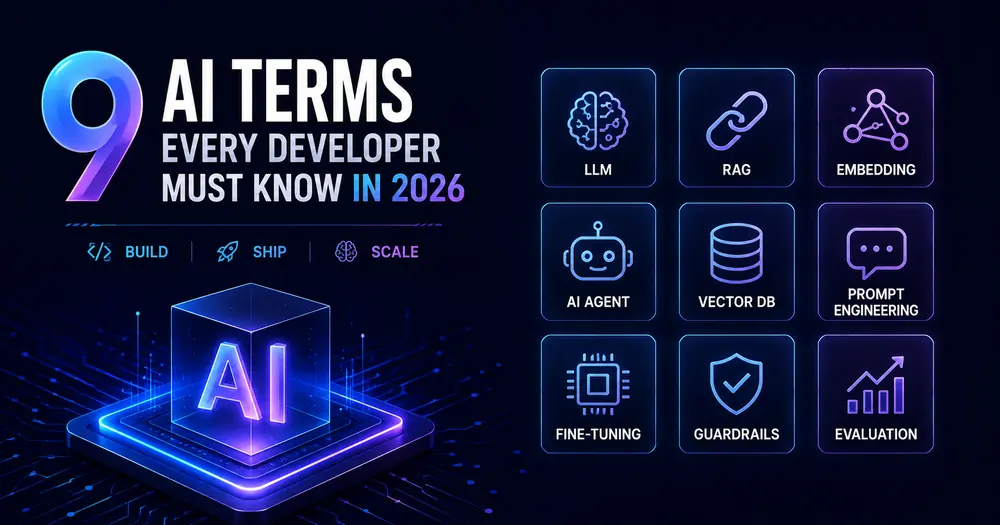
9 AI Terms Every Developer Must Know in 2026
Your AI feature works on your laptop. It demos clean, the output looks sharp, everyone nods in the standup. Then it hits real traffic — and starts forgetting half the conversation, inventing a refund policy that doesn’t exist, and quietly tripling your cloud bill.
The gap between those two states is mostly vocabulary. Not the marketing kind. The operational kind. The AI terms developers actually need in 2026 aren’t the ones on the keynote slides — they’re the ones that explain why the thing broke and which knob to turn.
So here’s the map. Nine concepts, each defined in plain language, each linking down to a deeper teardown when you want the internals. Skim it to fill gaps. Bookmark it for when something’s on fire at 2am.
Table of Contents
- Context Window
- Context Collapse
- Chunking
- GraphRAG vs Vector RAG
- Inference Cost
- KV Cache
- Quantization
- Guardrails
- Evals
1. Context Window
The context window is the maximum amount of text a model can hold in its head at once, measured in tokens. Your system prompt, the chat history, any retrieved documents, and the model’s own response all draw from that same budget. When you hit the ceiling, something gets dropped or truncated — usually the oldest content, and usually without warning.
Knowing your window size, and how full it is on a given request, is the line between an app that remembers and one that silently forgets the thing the user said three messages ago.
Read more → Why Bigger Context Windows Make Your AI Worse
2. Context Collapse
Here’s the part the spec sheet won’t tell you: filling the window doesn’t make the model smarter. Past a point, it makes it worse. Accuracy drops on facts buried in the middle of a long input, and output quality degrades as the input grows — even when there’s plenty of room left.
This is widely called context rot, a term Chroma’s 2025 research put on the map after testing 18 frontier models and finding every single one degraded as input length increased. Not most of them. All of them. The fix isn’t a bigger window — it’s ruthless curation of what you put in it.
⚠️ Note: “Context window” and “context collapse” only make sense as a pair. A larger window is more room to make this mistake, not a cure for it.
Read more → Why Bigger Context Windows Make Your AI Worse
3. Chunking
Before a RAG system can retrieve anything, you have to slice your documents into pieces. Chunking is how you slice them. Fixed character counts are easy and fast; semantic chunking (splitting on meaning — paragraphs, sections, ideas) is harder but keeps related text together.
Get it wrong and retrieval surfaces a fragment that cuts off mid-sentence, or splits the answer across two chunks so neither one looks relevant. Bad chunking is the most common reason a RAG system “can’t find” something that is very obviously sitting in the corpus.
Read more → Chunking Is Quietly Breaking Your RAG System
4. GraphRAG vs Vector RAG
Vector RAG retrieves by semantic similarity — perfect for “find me passages about X.” It struggles the moment a question requires connecting dots: how is A related to B through C? That’s a multi-hop query, and similarity search tends to fetch three loosely related chunks and hope the model stitches them together.
GraphRAG builds a knowledge graph of entities and their relationships, so traversal is the reasoning. Microsoft’s GraphRAG research reported double-digit gains in answer comprehensiveness over standard retrieval — but it costs real engineering time to build and keep in sync. Most teams in 2026 land on a hybrid: vector for the bulk of queries, graph for the relationship-heavy ones.
Read more → GraphRAG vs Vector RAG: When Relationships Beat Chunks
5. Inference Cost
Training is the down payment. Inference is the rent. Every token your app generates in production costs money, and it never stops — across a model’s lifetime, inference typically dwarfs training, with industry analyses putting it around 80–90% of total compute spend.
The confusing part: per-token prices keep falling (Stanford’s AI Index clocked a roughly 280× drop for GPT-3.5-level systems over two years) while your monthly bill keeps climbing. Usage grows faster than prices fall — agentic workflows alone can fire ten-plus model calls per user task.
Read more → Why Your AI Bill Is Almost All Inference (and How to Cut It)
6. KV Cache
To generate text fast, a transformer caches the keys and values it computed for every previous token instead of recomputing them on each new step. That’s the KV cache, and it’s the reason token-by-token generation isn’t agonizingly slow.
The catch: the cache grows linearly with context length and lives in GPU memory. Double your context, double the cache. It’s a big reason “just send more context” isn’t free even when the tokens technically fit — you’re paying in memory and latency, not just dollars per token.
Read more → The KV Cache: Why Long Context Isn’t Free
7. Quantization
Quantization shrinks a model’s weights from 16-bit floating point down to 8-bit or even 4-bit integers, so it needs far less memory and runs faster and cheaper. Naively, that sounds like it should destroy accuracy. It mostly doesn’t — modern methods lose surprisingly little.
That’s a quiet but huge story for 2026: high-quality 4-bit quantization is a big reason open-source models now run on a single consumer GPU and land within striking distance of the frontier on many tasks.
Read more → Quantization Explained: From FP16 to INT4 Without Wrecking Accuracy
8. Guardrails
Guardrails are the validation layer wrapped around your LLM: input filters, output checks, and policy enforcement that run before, during, and after generation. They’re what catch the prompt injection, the leaked PII, the confidently-wrong answer, or the off-topic reply before it reaches a user.
Shipping an LLM feature without them isn’t shipping a feature. It’s shipping a liability with a nice UI.
Read more → How to Add Guardrails to an LLM App Before You Ship It
9. Evals
Evals are systematic tests for AI behavior — measuring accuracy, catching regressions, probing edge cases — instead of “it looked good when I tried it twice.” They turn a model change from a gut call into a measurement: did this prompt tweak actually improve things, or just move the failures somewhere you didn’t look?
If your team can’t show you their evals, they’re not engineering. They’re guessing.
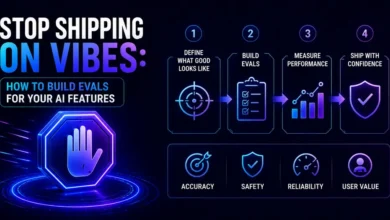
Read more → Stop Shipping on Vibes: How to Build Evals for Your AI Features
Which AI terms should developers learn first?
Depends on what’s hurting.
Building anything user-facing? Start with guardrails and evals — they’re the difference between a demo and a product, and they’re the two most teams skip. Debugging a RAG system that returns garbage? Go straight to chunking and context collapse; that’s where the bug usually lives. Watching the bill climb? Inference cost, then KV cache and quantization, in that order.
The four retrieval-and-context terms (window, collapse, chunking, GraphRAG) reinforce each other — read them as a set and the whole RAG stack stops feeling like magic. The cost trio does the same for your finance conversations.
💡 Tip — measure which concepts your audience cares about. If you’re publishing this as a pillar page, fire a GA4 custom event (or a GTM click trigger on the
read more →links) tagged with each term. After a week you’ll know which deep-dive to expand next, instead of guessing. Same principle as evals: stop shipping content on vibes.
FAQ
What are the most important AI terms for developers in 2026?
The nine that show up in real production problems: context window, context collapse (context rot), chunking, GraphRAG vs vector RAG, inference cost, KV cache, quantization, guardrails, and evals. They cluster into three buckets — what the model sees, what it costs, and whether it’s safe to ship.
What’s the difference between a context window and context collapse?
The context window is the capacity — how many tokens the model can take in. Context collapse (often called context rot) is what happens when you actually use a lot of that capacity: accuracy degrades, especially for information in the middle of the input. More window doesn’t fix collapse; better curation does.
Do I need to understand internals like KV cache to build with LLMs?
To call an API and ship a prototype, no. To explain why long-context requests are slow and expensive, or to make an informed cost decision, yes. KV cache and quantization are where “it just works” turns into “here’s exactly why it costs what it costs.”
What’s the single most overlooked AI concept on this list?
Evals. Guardrails get attention because failures are visible and embarrassing. Eval gaps are invisible — the feature seems fine — right up until a model update silently breaks it and nobody notices for a month.
The one that ties it all together
If you take a single idea from this list, make it the thread running through it: more is not better — curated is better. A bigger context window, more retrieved chunks, a larger model, more tokens — each feels like progress and each quietly degrades quality, cost, or both unless something downstream is doing the curating.
So pick the term that maps to your current headache and click into the deep dive. The glossary tells you what the word means. The teardown tells you what to do about it.