
Context Window vs Context Collapse: Why Bigger Backfires
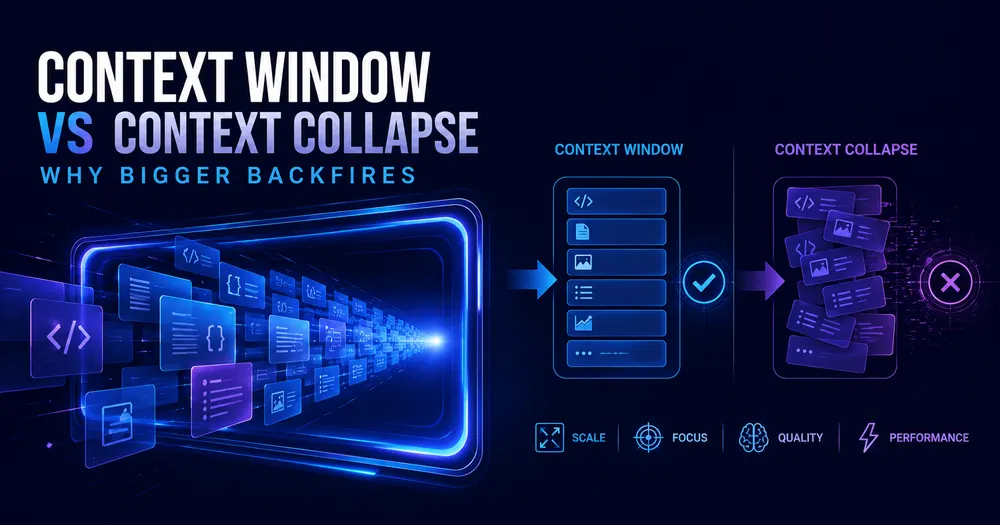
You upgraded to the model with the million-token window. You stopped agonizing over what to put in the prompt and started dumping everything in — the whole document, the full chat history, every retrieved chunk, all the tool output. More context, better answers. That’s the deal, right?
Then the answers got worse. Not crash-worse. Subtle-worse. The model misses a detail that’s plainly in the prompt, contradicts something from twenty messages back, confidently cites a fact that was never there.
That’s context collapse. It isn’t a bug in your code — it’s a property of how these models work, and it gets worse, not better, as you fill the window. The uncomfortable part of context window vs context collapse is that the two pull in opposite directions. The fix is the opposite of what the spec sheet implies.
Table of Contents
- The difference that actually matters
- Where the “more is better” myth comes from
- What the research actually found
- Why does context collapse happen?
- The fix is curation, not capacity
- Measure your effective context window
- When a big window is the right call
- FAQ
The difference that actually matters
A context window is capacity. It’s the maximum number of tokens a model can take in on a single request — prompt, history, retrieved docs, and the model’s own output, all sharing one budget. When people say a model has a “200K context window,” that’s the size of the bucket.
Context collapse is what happens when you actually fill that bucket. Accuracy drops. Recall of specific facts gets unreliable, especially for anything sitting in the middle of a long input. The model starts treating relevant and irrelevant tokens with roughly equal indifference.
Here’s the trap in one sentence: capacity and quality are not the same axis. A bigger window gives you more room to make this mistake — it doesn’t protect you from it. The two terms only make sense as a pair, which is exactly why this post covers both. (If you want the 30-second version of either, they both live in the AI terms every developer should know glossary.)
Where the “more is better” myth comes from
Walk back the last two years of model launches. Gemini 1.5 Pro shipped a 1M-token window in early 2024. GPT-4.1 matched it. Llama 4 advertised 10M. Every keynote framed the window as a headline capability — look how much it can read at once.
The implication landed hard: if the model can ingest your entire codebase, just give it your entire codebase. Stop retrieving, stop summarizing, stop chunking — feed it everything and let attention sort it out.
It’s an appealing story. It’s also wrong in a way that doesn’t show up in a quick demo, which is the worst kind of wrong. The demo uses a clean, short prompt. Production uses a bloated one. The gap between those two is where collapse lives.
⚠️ Note: “The window fits” is not the same as “the model will use it well.” Fitting is a token-count check. Using-it-well is an empirical question you have to measure for your task — more on that below.
What the research actually found
This stopped being anecdotal in mid-2025. A Hacker News commenter coined the phrase “context rot,” and the team at Chroma turned it into a controlled study: Context Rot: How Increasing Input Tokens Impacts LLM Performance (Hong, Troynikov & Huber, July 2025).
They tested 18 frontier models — GPT-4.1, Claude 4 (Opus and Sonnet), Gemini 2.5 (Pro and Flash), Qwen3, and more. The clever part of the design: they held task difficulty constant and varied only the number of input tokens. That isolates length as the cause, instead of confounding it with harder questions.
The headline finding is blunt. Models do not use their context uniformly — performance grows increasingly unreliable as input length grows, even on tasks that are deliberately trivial. Every single model degraded. Not most. All eighteen.
A few specifics worth internalizing, because they tell you what to fix:
- Distractors are poison. A single chunk that’s topically related but doesn’t answer the question measurably lowers accuracy versus a clean baseline. Four distractors compound the damage. Retrieving “more, just in case” actively hurts.
- Similarity matters. When the relevant passage is only loosely similar to the query, the decline at long lengths is sharper. Weak retrieval and long context are a bad combination.
- No model is immune, and none wins everywhere. Performance was, in the researchers’ framing, all over the place and highly task-dependent. Claude Sonnet 4 topped one task; GPT-4.1 topped another. There’s no “rot-proof” model to buy your way out with.
There’s an older, complementary result here too. Liu et al.’s Lost in the Middle showed LLM accuracy follows a U-shaped curve across position: information at the very start or very end of the input is recalled well, and information buried in the middle gets the worst recall. Put the one fact that matters at token 60,000 of 120,000 and you’ve hidden it in the model’s blind spot.
And the benchmark everyone used to wave around — needle-in-a-haystack — has quietly lost its meaning. Modern models ace it because it’s a lexical lookup. Real work needs semantic reasoning across messy context, which is precisely where they fall down.
Why does context collapse happen?
Three mechanisms stack on top of each other.
Attention gets diluted. A transformer distributes a finite amount of attention across every token in the input. Add more tokens and each one competes for a thinner slice. The relevant sentence is still in there — it’s just drowning in ten thousand neighbors all raising their hands.
Signal-to-noise is the real metric. This is the framing I find most useful day to day: output quality tracks the ratio of relevant to irrelevant tokens, not the raw count of relevant ones. Adding a relevant chunk plus nine irrelevant ones can make things worse, because you improved the numerator a little and blew up the denominator. Capacity is the wrong thing to optimize; ratio is the right one.
It’s not the same as overflow. Overflow is when you exceed the hard token limit and something gets truncated — a clean, detectable failure. Collapse happens well before the limit. A 200K-token model can degrade noticeably at 50K. Your logs show no error. Your code runs fine. The output just gets quietly less trustworthy.
For agents this is brutal, because context accumulates by default. Every file read, every search result, every tool output stays in the window for the rest of the session. The agent generates its own noise through exploration and backtracking, and that noise degrades every subsequent step. The model was smart enough to solve the task at step 3 — by step 30 it’s reasoning over a swamp.
There’s a cost dimension too, and it’s not small: a longer context means a bigger KV cache sitting in GPU memory, plus more tokens billed on every call. Collapse makes you pay more for worse answers. That’s the part that should sting.
The fix is curation, not capacity
If signal-to-noise is the metric, the job is obvious: put less in, but make sure what goes in earns its place. Four techniques, roughly in order of impact.
Retrieve wide, then rerank hard
The single highest-leverage change for most RAG systems. Don’t pass your top-50 vector hits straight into the prompt. Cast a wide net, then use a cross-encoder reranker to keep only the handful that actually answer the query.
# ❌ The "more is better" reflex — 50 chunks, ~40k tokens, mostly distractors
context = "\n\n".join(c["text"] for c in retriever.search(query, top_k=50))
answer = model.generate(prompt=f"{context}\n\nQuestion: {query}")Code language: Python (python)
# ✅ Curate: wide recall, then a reranker picks the real hits
from sentence_transformers import CrossEncoder
reranker = CrossEncoder("cross-encoder/ms-marco-MiniLM-L-6-v2")
def rerank(query, candidates, top_k=5):
pairs = [(query, c["text"]) for c in candidates]
scores = reranker.predict(pairs)
# keep only chunks that score well — every extra chunk is a potential distractor
ranked = sorted(zip(candidates, scores), key=lambda x: x[1], reverse=True)
return [c for c, _ in ranked[:top_k]]
candidates = retriever.search(query, top_k=50) # wide recall
top = rerank(query, candidates, top_k=5) # high precision
context = "\n\n".join(c["text"] for c in top) # ~4k tokens, far higher signal
answer = model.generate(prompt=f"{context}\n\nQuestion: {query}")Code language: Python (python)Going from 50 chunks to 5 reranked chunks routinely improves answer quality while cutting token cost roughly tenfold. Worse retrieval was making the long context look necessary. It wasn’t. (How you split documents in the first place feeds directly into this — see chunking strategy, because reranking can’t rescue chunks that were cut in the wrong place.)
Compact the conversation instead of hoarding it
In long chats and agent loops, don’t carry the raw transcript forever. Periodically summarize older turns into a compact running state and drop the verbatim history. You keep the information and discard the tokens.
The trigger is a budget, not a vibe:
import tiktoken
enc = tiktoken.encoding_for_model("gpt-4o")
def token_count(text: str) -> int:
    return len(enc.encode(text))
def maybe_compact(history: list[str], budget: int = 6000) -> list[str]:
    used = sum(token_count(m) for m in history)
    if used <= budget:
        return history
    # summarize everything except the last few turns, then rebuild the window
    head, tail = history[:-4], history[-4:]
    summary = model.generate(prompt=f"Summarize for continuity:\n{''.join(head)}")
    return [f"[Summary of earlier turns]\n{summary}", *tail]Code language: Python (python)
Kill distractors and stale context
Since the research shows a single distractor measurably hurts, treat irrelevant context as a bug, not as harmless padding. In agent systems, prune tool outputs you’ve already acted on. Drop the full API response once you’ve extracted the field you needed. Don’t leave a 20K-token JSON blob in the window for the next forty steps “in case.”
Mind the position
Given the U-shaped curve, put the most important material at the start or end of the input, never the middle. If you have one critical instruction and a pile of reference text, the instruction goes last (closest to the generation), not sandwiched in the middle of the docs.
💡 Tip: A quick gut-check before any LLM call — if you can’t say why each block of context is in there, it probably shouldn’t be. Context is a liability you’re choosing to take on, not a free resource.
Measure your effective context window
The spec sheet number is marketing. The number that matters is your maximum effective context window — the point where accuracy on your task actually holds up. The only way to know it is to test, which is the same discipline behind building real evals.
Build a tiny harness that plants one true fact in increasingly large piles of plausible-but-irrelevant filler, then watch where accuracy falls off:
import random
def build_haystack(needle, filler_chunks, target_tokens, enc):
    """Embed one true fact among on-topic-but-irrelevant filler (real distractors)."""
    context, tokens = [needle], len(enc.encode(needle))
    random.shuffle(filler_chunks)
    for chunk in filler_chunks:
        t = len(enc.encode(chunk))
        if tokens + t > target_tokens:
            break
        context.append(chunk)
        tokens += t
    random.shuffle(context)   # vary needle position — middle is the worst case
    return "\n\n".join(context)
for length in [2_000, 8_000, 32_000, 64_000, 128_000]:
    haystack = build_haystack(needle, filler, length, enc)
    answer = call_model(question, haystack)
    print(length, score(answer, expected))   # find the length where the score cratersCode language: Python (python)
That cliff is your real budget. I haven’t found a model yet where it matches the advertised window — usually it’s a fraction of it, and it moves with how good your retrieval and how nasty your distractors are. Benchmark it for your own data; don’t trust mine.
On the analytics side, the same instinct pays off in production. Log the input token count alongside a quality signal — thumbs-up/down, a correction rate, an answer-accepted event fired through GA4 or your GTM dataLayer. Segment quality by context length and you’ll see collapse in your own dashboards, not just in a paper. That’s a real backlink magnet, incidentally: teams love a metric they can actually watch.
When a big window is the right call
This isn’t an argument for tiny prompts everywhere. There are genuine cases where a large window earns its keep:
- Single-document reasoning where the whole doc is relevant and there’s nothing to retrieve — reading one contract end to end, say.
- First-pass exploration where you don’t yet know what to retrieve and need the model to survey a lot of material once.
- Tasks below your measured cliff, where you’ve tested and confirmed quality holds at that length.
The honest tradeoff: large context buys you simplicity (no retrieval pipeline to build) at the cost of money, latency, and — past your effective limit — accuracy. For a weekend prototype, simplicity wins. For a production feature serving real volume, the inference bill and the quality floor usually push you back toward curation. Your mileage may vary on a low-traffic internal tool; benchmark before you architect.
The takeaway
Stop treating the context window as a target to fill and start treating it as a budget to defend. The model isn’t a database that gets smarter with more rows — it’s a reader that gets distracted with more pages. Curate ruthlessly, put the important thing where the model actually looks, and measure where your own task starts to rot. The team that does this ships more reliable AI on a smaller, cheaper window than the team still chasing the bigger number.
FAQ
What is the difference between a context window and context collapse?
The context window is capacity — the maximum tokens a model can accept at once. Context collapse (also called context rot) is the quality degradation that happens as you fill that capacity: accuracy drops, especially for facts in the middle of long inputs. Bigger windows don’t prevent collapse; they enlarge the space where it can occur.
Does a bigger context window improve accuracy?
Not on its own. Chroma’s 2025 study of 18 frontier models found that performance degrades as input length grows, even on simple tasks. What improves accuracy is a high signal-to-noise ratio — fewer, more relevant tokens — not raw capacity.
What is context rot?
Context rot is the term, formalized by Chroma’s 2025 research, for measurable LLM performance decline as input length increases. It happens well before the model’s hard token limit, so a 200K-token model can degrade noticeably at 50K tokens with no error or truncation.
How do I stop context collapse in my RAG app?
Curate the context instead of expanding it. Retrieve wide then rerank to a handful of chunks, compact long conversation history into summaries, remove distractors and stale tool outputs, and place critical information at the start or end of the prompt rather than the middle. Then measure your effective context length on your own task.
Is RAG still necessary if models have million-token context windows?
Yes, arguably more so. A large window makes it tempting to skip retrieval and dump everything in, which maximizes distractors and triggers collapse. Good retrieval is what keeps the signal-to-noise ratio high regardless of how big the window is.